Thursday, 14 October 2010

Myth Country II

Illustration to Wordsworth's The Deserted Cottage by Birket Foster


Where the cliff ends, the land runs steeply to the sea. The sound of waves, the barking of seals who lie on the rocks, dive and reappear.

The land is wooded and the trees reach to the beaches. A path follows the sea and the edge of the woods, running in, bridging streams, coming out upon coves and folding back into the woods. There is always the scent of damp, and in spring Blackthorn and Hawthorn blossom above Wild Garlic.

From the woods the path climbs another cliff, through Thrift, Sea Cabbage and Bladder Campion; past the ruined chapel, the fallen cottages that are now just stones. Some are larger, more recently vacated. They bear traces of upper floors, the shells of fireplaces and bread ovens or they house rusted iron bedsteads or parts of ploughshares. Grass grows from the upper stones. Gulls nest in the frames of windows and brambles hide the doorsteps.


*** This is my (brief) response to Doris Lessing's claim that 'Every writer has a myth-country.' It follows Jenny's and Rebecca's pieces on the same theme, published here and on Rebecca's site, and is probably linked to a piece that I wrote some months ago on my day-dream island.

Tuesday, 5 October 2010

Myth Country by Jenny Walters

Alexander Hogue, Mother Earth Laid Bare


This country is my island of myth,
Where I root my feet to the earth,
Wriggle my toes under the grass
to anchor myself.
I throw back my head,
Stretch out my arms
and grow.

Now I am tall I can cover miles in one stride,
Feel the soft Sussex meadow under my bare feet
and the spikes of the coppiced woods
that snap like charcoal.
Heading north to London and the heat
of the summer concrete rises up and warms the backs
of my thighs.
I scatter cars with my fingers
and wink at cheeky office workers
in skyscrapers with my sky blue eye.
I catch a passing plane in both hands
and abseil off the salty coast.
I crush handfuls of native oysters
in my massive teeth. Shells and all.
I plunge through the waves like a whale
and wave at chalky cliffs.
I haul myself onto the beach at Cornwall
and plop into the sand.
For a moment still.
The sun fills my insides
and rises up to my mountainous breasts.
Some beach-goers are frightened.
Some have been crushed.
I laugh and shake the sand from my hair.
Running fast now, east.
Slowing my pace I start to shrink
with each step.
And here in this country lane
I lie down on the warm tarmac
and sigh.


Jenny's poem was inspired by Doris Lessing's claim that 'Every writer has a myth-country' (African Laughter). Jenny, Rebecca and I have each written about our myth countries, and this piece first appeared last month on Rebecca's site. More to follow....

Monday, 27 September 2010

The Abandoned House

Past hope, past hunger,
I am my loose steps,

my fly-by-night boards;
brambles sprawled upon a chair;

missing banisters;
the footprints of foxes;

cupboards of workaday and best china;
records; tins of polish, paraffin.

I am folding inwards,
till my roof collapses,

till mortar falls from brick
and plants seal me

in this homeless home,
this seed case.

Here’s the fire I set for warmth,
or to end, to still

the talk of rodents,
the tongues of curtains.


***This poem has just been published in isssue 7 of Swamp
.


*** And here are the latest additions to my family:


Monday, 20 September 2010

After Ovid (and Flo)


issertations are cruel beasts. They weigh a great deal and and have sharp teeth and claws. Having worried me for over a year, mine climbed on to my back sometime in late July and refused to let go, clinging to my neck and shoulders till they ached, breathing in my ear at night, so that my dreams were nightmares and I woke up before dawn and couldn't get back to sleep again. Its breath was so hot that my skin and hair shrivelled. It scratched my eyes till they were red and swollen. It made whatever I tried to eat huge and indigestible and it got into my stomach and twisted my intestines. When it was on my shoulders it whispered to me that I wasn't good enough, that I would crack, that I wouldn't finish on time. It made me so afraid that my words got stuck inside and I had to force them out one by one.

In the few moments when it left my side it created a mountain range of books in my sitting room, which kept changing and growing, so that I could never find the one I needed.

I went for fast walks, trying to get away from it, but it was always the only thing in front of my eyes. August passed. I am told it rained.

And then one morning a week before my dissertation was due, my cat, Flo, was killed by my neighbours' dog. For a few hours I became present again, almost relaxed. I was forced to notice the ash trees beyond my window, and the ripples of light on their leaves, their movement in the wind. I saw that they were beginning to change colour and that autumn was coming. I found I was once more sitting on my sofa on a sunny morning at the end of August, not solving any puzzles or making any connections or thinking about the beast at all. For a few hours it left me alone. There was a stillness, which I hadn't known for weeks. My husband and I took the morning off work and went for a walk, carrying the first of our pain and anger out of the house with us, walking it across the fields, trying to earth it in the Boletes that we collected for lunch.

The day after, I remembered a poem by Sharon Olds:

Easter 1960

The doctor on the phone was young, maybe on his
first rotation in the emergency room.
On the ancient boarding-school radio,
in the attic hall, the announcer had given my
boyfriend's name as one of two
brought to the hospital after the sunrise
service, the egg-hunt, the crash - one of them
critical, one of them dead. I was looking at the
stairwell banisters, at the lathing,
the necks and knobs like joints and bones,
the varnish here thicker here thinner - I had said
Which one of them died, and now the world was
an ant's world: the huge crumb of each
second thrown, somehow, up onto
my back, and the young, tired voice
said my fresh love's name. It would have been
nice to tear out the balusters, and rail, and the
stairs, like a big backbone out of a
brontosaur, to take some action,
to do, and do, as a done-to, and
dear one to a done-to-death-to, to have run, on a
treadmill, all night, to light the dorm,
the entire school, with my hate of fate,
and blow its wiring, and the town's wiring,
pull the wires of Massachusetts
out of the switchboard of the country. I went back to my
room, I did not know how to get
out of the world, or how to stay -
I sat on the floor with the Sunday Times
and read the columns of the first page down,
and then the next, and then the next.
I can still see how every a,
initiator of his given name,
looked eager - it hadn't heard yet, that its
boy was gone - and every f
hung down its head on its broken neck,
its little arms held out, as if to
say, You see me, this is what I am.


I got rid of the dissertation beast two weeks ago, dismantling its mountains on the Sunday evening and handing it in at 9.40 the next morning. I staggered beneath the two armfuls of books that I had to take back to the library. Other post-grad's smiled sympathetically as I passed. One remarked that he'd been wondering where all the books had gone.

I drove home very fast and dangerously and that night I got drunk.

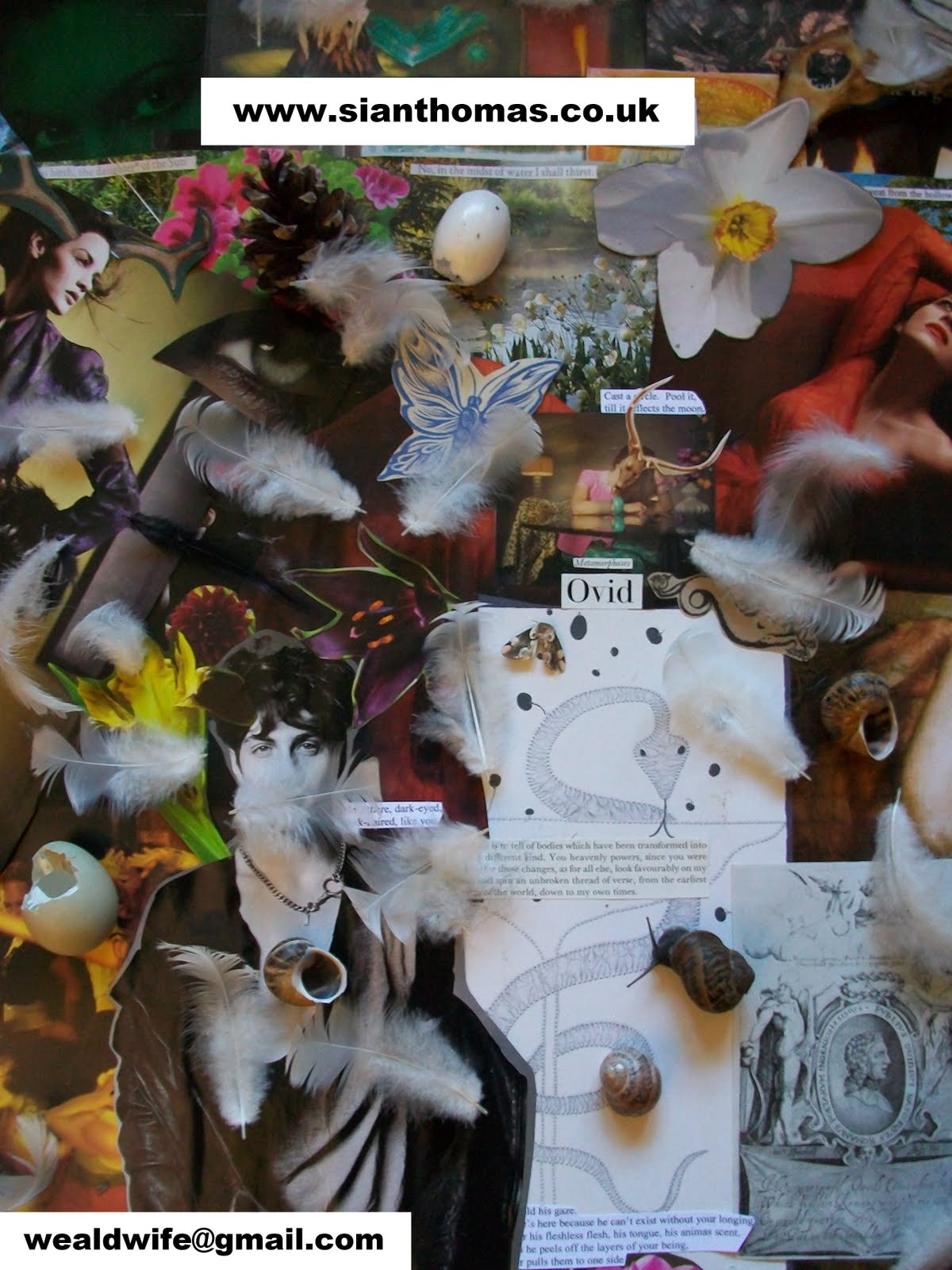
The beast's ghost is still with me, though my osteopath and I are doing our best to exorcise it. After handing it in, I cleaned the house and tidied the pile of letters, pens, pencils and old, sticky sweets that had gathered in my corner of the sitting-room. I removed my Ovid vision board and hid it upstairs.

We went on holiday last week to the Forest of Dean. While we were there, to further shake it off, I threw a stick into the fast-flowing river Wye, imagining it was my no-longer-needed past. I don't know whether the beast jumped in after the stick, but I think I can still feel it around me.

Flo is here too, though she's a welcome presence. I keep seeing her in the house, a little black shape on the bed, or sliding on the tiles in the kitchen in her hurry to go out to the garden. I hear her cracked 'Ack' of a meow as she comes downstairs to greet me. At least now I have the time to miss her.

Monday, 9 August 2010

Down the Rabbit Hole Once Again


I am going into the Underworld to finish my Ovid work and probably won't surface until the middle of September.

Monday, 19 July 2010

Home


ast week's conference was a fascinating experience and I learned a great deal about myth and particularly about myths of nationhood. It prompted me to think about my own identity, both as a poet among academics (I was one of a very few people there working with myth in a strictly creative way) and also as an English poet with a Welsh name. I have always felt confused about my national identity. When I ran an internet community some years ago, new members would sometimes greet me with, 'Bore da.' Quite a number of people I met at the conference asked me if I was Welsh. Certainly, Welshness is a fine inheritance for any poet and the associations that come with my name (I like to fantasise that I'm related to Dylan, Edward and R.S) were one reason why I kept it when I married. But I am not Welsh and I have never had to hold to a strong sense of national identity in the face of a the kind of bullying the English have historically inflicted upon the Welsh. I am aware of the blend of French, Irish, Scottish, English, German, Russian and probably Welsh sap that runs through my family tree. I'm afraid I don't know what it means to be English, aside from a sense of embarrassment about, well, everything.

As soon as I got home I went into our garden to let the hens out and to let Sylvia rejoin the others. I was glad to be home, to feel Wealden clay hard-baked beneath my feet. My identity is bound up with the Weald. I feel more Sussex than English and more Wealden than Sussex (though I must admit to feeling I belong to the Sussex Weald most of all, mythical as the concept is), even though my parents weren't born in this area. The Weald is real, it's the clay, the landscape of this part of the world and nowhere else. I can touch it. I know its particular smell. I know the streams, the woods, the hills here. My house is built of bricks that were dug from the earth only a few miles away. I know where the water in my taps comes from. I know where much of the food I eat is farmed. I know where the nearest abattoir is. Perhaps it is precisely because Englishness is so slippery and so fraught with tension that I feel an affinity with this bit of the land, which Peter Brandon describes as 'a region of antonyms. Its wonderful impression of fecundity and tranquil beauty [...] has always belied grudging clays wearily farmed to the very limits of practical credibility.' There's something about Brandon's description that I and many of my Wealden friends can identify with: whatever tranquil beauty we may have is founded on grudging clay.

On Monday morning, I sat at the bottom of my garden and wrote about the Weald. Beneath my feet, the grass had worn away and the ground was dusty. I pushed the dust with my toes and remembered the same sensation, thirty years ago, making fairy houses in the roots of trees in the playground of my primary school. The soil in my garden is the grey-tan colour of Wealden sandstone. Now, in summer heat, there are runs in it, cracks. Near where I was sitting, hogweed was flowering. By the end of summer the flower stems will be hollow, easy to pull out. My brother, Mash, and I used to use hogweed stems as swords in the camps we built in the field behind our house.

Later that day, I walked in Parsons Wood. To cool down, I paddled, or rather stood, in the stream. I watched insects fall into the water, which moved so slowly that the mud inside it looked like smoke. Some of it silted on my feet and it felt as though I was turning into the stream bed. There were mud-coated, filigreed leaves in the water, decomposing on the bottom. Sunlight came through the beech leaves and the far bank was emerald green with moss.

I left the water, carrying my shoes. The sensation of walking barefoot was so pleasing that I continued shoeless into the fields, putting them on again only to cross the thistles near the clootie tree, taking them off again as soon as I could. I noticed that I trod softly, that I was forced to move a little slower and with greater care. I felt the changes between grass and clay.

When I left the woods, I walked barefoot through the village, over hot and cool tarmac and brick paving, through the run-off from the small chalybeate spring and back to my house. My feet were hot and sore and my back ached slightly. I think my posture must have changed in response to my shoelessness. I made a cup of tea and Flo, my cat, came to sit beside me on the sofa. She lay on her side, purring and gazing up at me. I picked up my copy of Metamorphoses, my notebook and my favourite pen and got back to work.Check Spelling


***I drew the decorated L some months ago and then forgot about it, probably because it's a funny little thing. Its leekishness is a coincidence & I hope it doesn't cause any offence to Welsh readers!

Monday, 12 July 2010

Time Glides Away II


So, I am set for the conference. I've printed a stack of cards with my contact details (pictured above), made from a vision board I assembled a couple of months ago. I've also finished the last alterations to my paper; read it aloud many times to my husband, Phill, our cat, Flo, and our fox-mauled hen, Sylvia, who's currently living in the house, roosting on the side of the bath at night and raiding our compost bin during the day. She's been inside for the past two weeks and doesn't seem at all interested in the garden any longer. Instead, she's developed a fondness for Radio Three (we tried her on Radio Six, but it made her squawk) and seems to like Baroque music most of all. I may well have to take her to Handel's Rinaldo at Glyndebourne next year: a perching ticket, perhaps?

Tomorrow, saying Goodbye to family (furred, feathered & otherwise), I'll catch a train to London to meet Terri at Charing Cross. Together we'll go to the V & A, where we'll look at lots of small spaces & get excited about spatial theory.

On Wednesday, having said Goodbye to Terri and her family (furred and Neil-her-lovely-chap-shaped) I'll catch two further trains from Euston to Birmingham and from Birmingham to New Town, Powys; followed by a taxi to Gregynog Hall and three days of conference joy.

Lastly, on Friday, I'll say Goodbye to the gorgeous Gregynog and its 750 acres of gardens and catch a fourth and final train to Cardiff, where I'll meet Phill again and together we'll go to our friend Donal's birthday party in the Celtic round house on his (mostly human) family's land in St. Hilary.

While we're away, the gorgeous Caroline has kindly agreed to look after the furred and feathered crew. She is under instructions to leave the radio on.