Thursday, 11 November 2010

My Life is Better Without You Because...


Illustration by Corinna Sargood, from Angela Carter's Book of Fairy Tales


My life is better without you because you used to make me sandwiches with horrible fillings, such as jam and sausages, or ham and bananas; then you'd watch me eat them and snigger to yourself. Sometimes I was sick.

My life is better without you because once when I was weeding the drive you came back from the shops and ran me over. My ribs and pelvis were crushed and I was in hospital for five months. Even now it's hard to breathe. You didn't apologise.

My life is better without you because you used to do the hoovering at 2am and would hit the bed repeatedly with the upholstery attachment. Then you would hoover the mattress, poking the nozzle beneath me and catching the hem of my pyjama top.

My life is better without you because whenever I tried to leave you, you hired security people to find me and take me back. I could never get further than a few miles away because you took away my bicycle, my car, my passport and my money. I had to sleep in fields and hedges; so I couldn't leave in cold or wet weather. Once I knocked on my neighbour's door and asked for shelter, but somehow you knew I was there and came for me. I wondered sometimes whether you controlled the world.

My life is better without you because you always knew what I was thinking and I was scared to think anything bad in case you saw it. I used to wake up shaking whenever I had nightmares about you, when my dreams were begging me to leave you. I was so afraid you'd see them.

***I wrote this piece last Saturday as part of the Day of Meaningful Nothing. Jenny suggested we write on this theme, as she, Rebecca and I love Luke Kennard's prose poem, ' My Friend', which I won't reprint here as would put my own piece to shame. She also reckoned it might be cathartic for us all to write about getting rid of someone who used to cause us pain. I didn't want to write about any real people, as I still miss most (though not all) of the people I'm no longer in contact with. Instead then I wrote about someone fictitious. It was only when I came to read it out that I realised it was actually loosely autobiographical, describing among other things aspects of my childhood. It prompted much discussion among Jenny, Rebecca, Suzanne, Terri and I about childhood: being forced to eat food we didn't like, being powerless and unable to run away, believing our parents were telepathic, and, of course, angry maternal hoovering.

Rebecca has given an excellent account of the day on her website. I can't add to her description, but I would like to thank my four fellow Meaningful Somethings for filling it with their creativity, honesty, sensitivity, intelligence and good humour.


Friday, 5 November 2010

Creative Panic


hat should we do when we can't write anything of any quality? Should we carry on working through the drought?

I've just come to the end(ish) of 600 or so lines of a narrative poem I started at the beginning of the year. Since the MA ended I've been preoccupied with finishing various projects that I just haven't had the time for until now, one of which has been the narrative piece.

Ovid needs further work too, but I'm stuck in the Battle of Lapiths and Centaurs and frankly I find the fights the least interesting tales in Metamorphoses: I have problems remembering which centaur has his head crushed so that his brains come out through his nose, eyes, mouth and ears; or which gets tangled in and trips over his own intestines. I'm sure I shouldn't admit this, but I don't much care: having recently read both The Golden Notebook and The Women's Room, a bunch of men, even ones with hooves, chopping one another up and pulverising each other with tree trunks seems no great shakes.

But I'm not getting on with anything new and that's the rub. Should I? Is it best to tie loose ends, or begin weaving new ones? If I finish everything, what will I do then? I'm afraid that
if I don't begin anything I'll forget how to do it and end up in serious creative panic. It's like beginning a new notebook: all those blank pages that demand brilliance but so often end up covered in mistakes and non-starters.

This is familiar territory, of course, and I guess it will pass. It's probably partly due to the post MA void: my life feels a bit like a new notebook at the moment. Perhaps I need to learn not to worry so much about the future.

Tomorrow I have some friends coming over for a Day of Meaningful Nothing, that is, a day of talking, voice-workshopping, cake and alchemical stew-eating and vision-board-making. I am so looking forward to a full day of creativity and I hope it might ease my panic. In the meantime there are just those dying centaurs to contend with.

Friday, 15 October 2010

Eye Walk the Weald


Eye walk the Weald: path, hollow, abandoned highway, impassable in winter, bramble-bracken-deep in June. I carve myself into the earth, each step wearing it away, clagging it or cracking. I breathe the south-west wind. My bones are sandstone, my muscles clay. My blood is thick with iron. I shake my head and oak leaves fall. From the freckles on my arms, speckled butterflies take flight. The dandelions tick-tock my steps from stile to stile, from the meadow-burst of thistles, finches, to the wood, in stinkhorn fug and honeysuckle. Dappled, I sing in blackbird trill, cow call, the hymns of gnats, the leather-rub of leaves.


***This piece first appeared as part of Tunbridge Wells Borough Council's EyeLife arts project.

Thursday, 14 October 2010

Myth Country II

Illustration to Wordsworth's The Deserted Cottage by Birket Foster


Where the cliff ends, the land runs steeply to the sea. The sound of waves, the barking of seals who lie on the rocks, dive and reappear.

The land is wooded and the trees reach to the beaches. A path follows the sea and the edge of the woods, running in, bridging streams, coming out upon coves and folding back into the woods. There is always the scent of damp, and in spring Blackthorn and Hawthorn blossom above Wild Garlic.

From the woods the path climbs another cliff, through Thrift, Sea Cabbage and Bladder Campion; past the ruined chapel, the fallen cottages that are now just stones. Some are larger, more recently vacated. They bear traces of upper floors, the shells of fireplaces and bread ovens or they house rusted iron bedsteads or parts of ploughshares. Grass grows from the upper stones. Gulls nest in the frames of windows and brambles hide the doorsteps.


*** This is my (brief) response to Doris Lessing's claim that 'Every writer has a myth-country.' It follows Jenny's and Rebecca's pieces on the same theme, published here and on Rebecca's site, and is probably linked to a piece that I wrote some months ago on my day-dream island.

Tuesday, 5 October 2010

Myth Country by Jenny Walters

Alexander Hogue, Mother Earth Laid Bare


This country is my island of myth,
Where I root my feet to the earth,
Wriggle my toes under the grass
to anchor myself.
I throw back my head,
Stretch out my arms
and grow.

Now I am tall I can cover miles in one stride,
Feel the soft Sussex meadow under my bare feet
and the spikes of the coppiced woods
that snap like charcoal.
Heading north to London and the heat
of the summer concrete rises up and warms the backs
of my thighs.
I scatter cars with my fingers
and wink at cheeky office workers
in skyscrapers with my sky blue eye.
I catch a passing plane in both hands
and abseil off the salty coast.
I crush handfuls of native oysters
in my massive teeth. Shells and all.
I plunge through the waves like a whale
and wave at chalky cliffs.
I haul myself onto the beach at Cornwall
and plop into the sand.
For a moment still.
The sun fills my insides
and rises up to my mountainous breasts.
Some beach-goers are frightened.
Some have been crushed.
I laugh and shake the sand from my hair.
Running fast now, east.
Slowing my pace I start to shrink
with each step.
And here in this country lane
I lie down on the warm tarmac
and sigh.


Jenny's poem was inspired by Doris Lessing's claim that 'Every writer has a myth-country' (African Laughter). Jenny, Rebecca and I have each written about our myth countries, and this piece first appeared last month on Rebecca's site. More to follow....

Monday, 27 September 2010

The Abandoned House

Past hope, past hunger,
I am my loose steps,

my fly-by-night boards;
brambles sprawled upon a chair;

missing banisters;
the footprints of foxes;

cupboards of workaday and best china;
records; tins of polish, paraffin.

I am folding inwards,
till my roof collapses,

till mortar falls from brick
and plants seal me

in this homeless home,
this seed case.

Here’s the fire I set for warmth,
or to end, to still

the talk of rodents,
the tongues of curtains.


***This poem has just been published in isssue 7 of Swamp
.


*** And here are the latest additions to my family:


Monday, 20 September 2010

After Ovid (and Flo)


issertations are cruel beasts. They weigh a great deal and and have sharp teeth and claws. Having worried me for over a year, mine climbed on to my back sometime in late July and refused to let go, clinging to my neck and shoulders till they ached, breathing in my ear at night, so that my dreams were nightmares and I woke up before dawn and couldn't get back to sleep again. Its breath was so hot that my skin and hair shrivelled. It scratched my eyes till they were red and swollen. It made whatever I tried to eat huge and indigestible and it got into my stomach and twisted my intestines. When it was on my shoulders it whispered to me that I wasn't good enough, that I would crack, that I wouldn't finish on time. It made me so afraid that my words got stuck inside and I had to force them out one by one.

In the few moments when it left my side it created a mountain range of books in my sitting room, which kept changing and growing, so that I could never find the one I needed.

I went for fast walks, trying to get away from it, but it was always the only thing in front of my eyes. August passed. I am told it rained.

And then one morning a week before my dissertation was due, my cat, Flo, was killed by my neighbours' dog. For a few hours I became present again, almost relaxed. I was forced to notice the ash trees beyond my window, and the ripples of light on their leaves, their movement in the wind. I saw that they were beginning to change colour and that autumn was coming. I found I was once more sitting on my sofa on a sunny morning at the end of August, not solving any puzzles or making any connections or thinking about the beast at all. For a few hours it left me alone. There was a stillness, which I hadn't known for weeks. My husband and I took the morning off work and went for a walk, carrying the first of our pain and anger out of the house with us, walking it across the fields, trying to earth it in the Boletes that we collected for lunch.

The day after, I remembered a poem by Sharon Olds:

Easter 1960

The doctor on the phone was young, maybe on his
first rotation in the emergency room.
On the ancient boarding-school radio,
in the attic hall, the announcer had given my
boyfriend's name as one of two
brought to the hospital after the sunrise
service, the egg-hunt, the crash - one of them
critical, one of them dead. I was looking at the
stairwell banisters, at the lathing,
the necks and knobs like joints and bones,
the varnish here thicker here thinner - I had said
Which one of them died, and now the world was
an ant's world: the huge crumb of each
second thrown, somehow, up onto
my back, and the young, tired voice
said my fresh love's name. It would have been
nice to tear out the balusters, and rail, and the
stairs, like a big backbone out of a
brontosaur, to take some action,
to do, and do, as a done-to, and
dear one to a done-to-death-to, to have run, on a
treadmill, all night, to light the dorm,
the entire school, with my hate of fate,
and blow its wiring, and the town's wiring,
pull the wires of Massachusetts
out of the switchboard of the country. I went back to my
room, I did not know how to get
out of the world, or how to stay -
I sat on the floor with the Sunday Times
and read the columns of the first page down,
and then the next, and then the next.
I can still see how every a,
initiator of his given name,
looked eager - it hadn't heard yet, that its
boy was gone - and every f
hung down its head on its broken neck,
its little arms held out, as if to
say, You see me, this is what I am.


I got rid of the dissertation beast two weeks ago, dismantling its mountains on the Sunday evening and handing it in at 9.40 the next morning. I staggered beneath the two armfuls of books that I had to take back to the library. Other post-grad's smiled sympathetically as I passed. One remarked that he'd been wondering where all the books had gone.

I drove home very fast and dangerously and that night I got drunk.

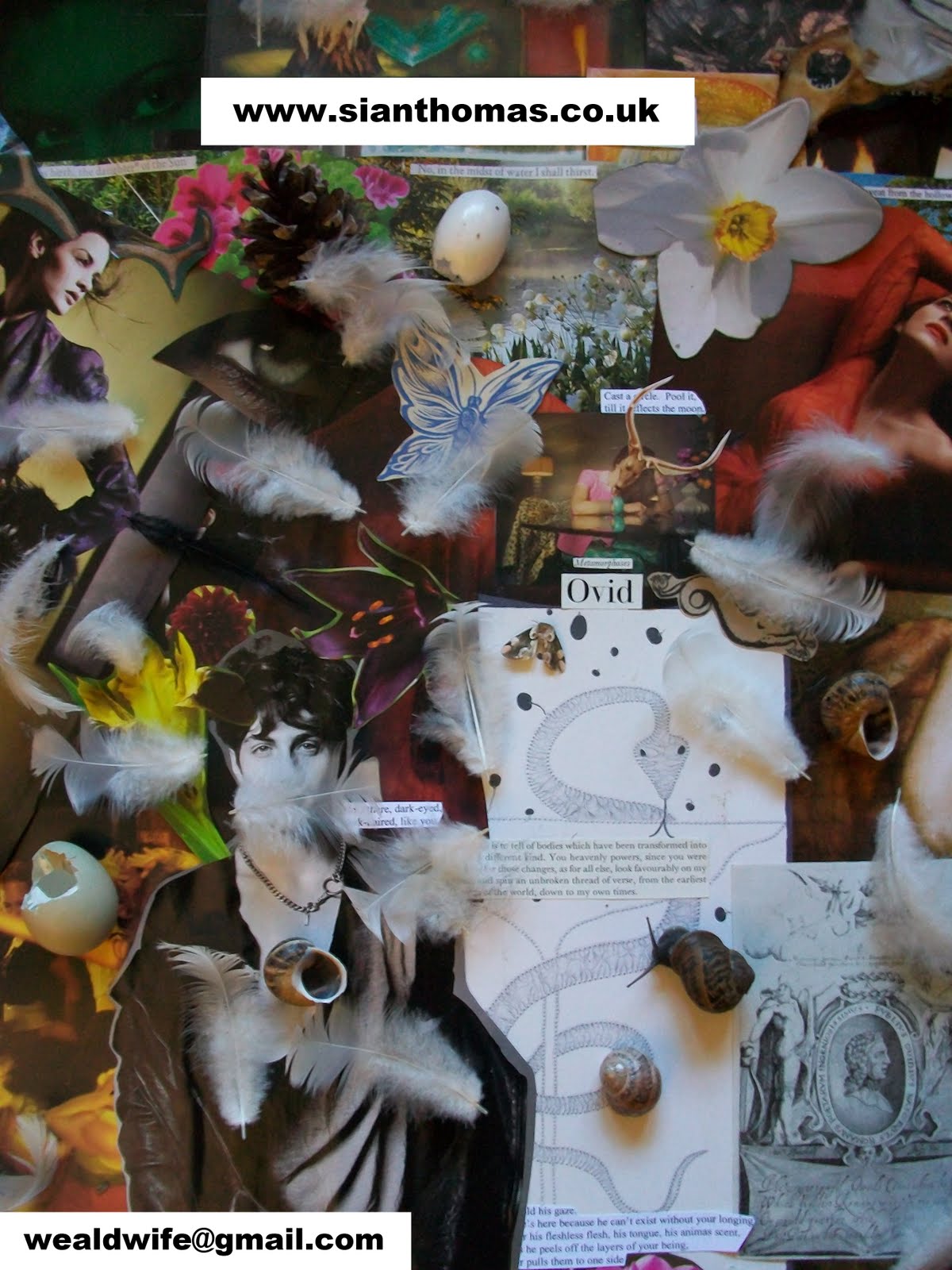
The beast's ghost is still with me, though my osteopath and I are doing our best to exorcise it. After handing it in, I cleaned the house and tidied the pile of letters, pens, pencils and old, sticky sweets that had gathered in my corner of the sitting-room. I removed my Ovid vision board and hid it upstairs.

We went on holiday last week to the Forest of Dean. While we were there, to further shake it off, I threw a stick into the fast-flowing river Wye, imagining it was my no-longer-needed past. I don't know whether the beast jumped in after the stick, but I think I can still feel it around me.

Flo is here too, though she's a welcome presence. I keep seeing her in the house, a little black shape on the bed, or sliding on the tiles in the kitchen in her hurry to go out to the garden. I hear her cracked 'Ack' of a meow as she comes downstairs to greet me. At least now I have the time to miss her.