Tuesday, 11 January 2011

Street Photograph V in Twenty-One Syllables


Between the automatic doors
of the Museum and the Mall
I moved in Nothing.

Tuesday, 4 January 2011

Street Photographs III & IV in Twenty-One Syllables


ere are two further street photographs in twenty-one syllables.

The first instruction, over Christmas, was to 'Look closer to home'. This is my response:

At your parents' too hot house
your mum worries as
your dad forks soft sprouts.
His hands are bruised.


And this week's is, 'Show us the aftermath':

After the Christmas tree
I vacuum pine needles,
tinsel, solstice night,
expectation.

Friday, 24 December 2010

Advent Calendars

December has galloped by and I've said almost nothing here. I've been in the grip of what I can only (but rather pretentiously) describe as an experience of gnosis. For most of this month I haven't known who I was, how to relate to the world around me, or what on earth to say here.

Fortunately the spiritual dust is settling now, and so, full of seasonal bonhomie, I thought I'd tell you about my advent calendars.

I have two calendars, which I've owned since I was a child. The first came from a National Trust shop in, I think, 1980. Here it is:


It's very battered and the tabs that held its roof together are floppy and largely useless. There's some dry, flaking Sellotape where once I stuck the roof together. Some of the doors are ripped and there's brown card and scratches on the pictures inside from the year I decided to glue the windows flat:


Much of 24 is torn and Joseph is almost entirely erased, poor man, except for his rhubarb pink face and custard yellow hair:


The calendar has a lovely seventies psychedelic look about it that reminds me of my mother's book on astrology from around the same period. Even Father Christmas looks like he's been taking fly agaric:


Perhaps most of all I love the pink and red fish scales on the roof and the curtains at the windows:


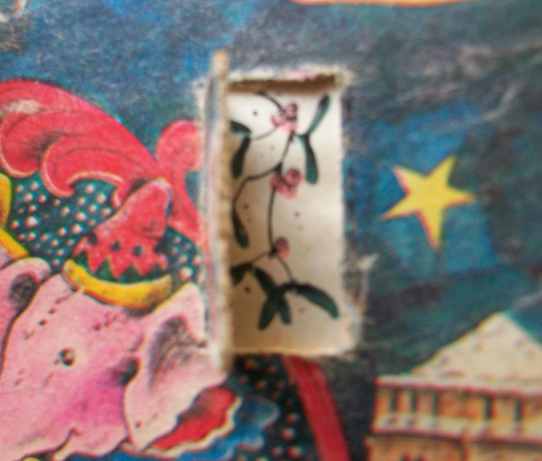
The second calendar comes from my mother's Woman and Home magazine in 1981. Every year for some years the December issue included an advent calendar that children could cut out, stick on to a cereal packet and get excited about thereafter:


The pictures inside were ink drawings only, so they could be coloured in. I'm still impressed with the care my brother (then eleven) and I (nine) took to do this: we've barely gone over the edges:


There are a few oddities, however, such as the spring-green antlers on the reindeer:


and the pink berries on the mistletoe:


but by and large it's a delicate beast with an unusual twenty-five doors:


The calendars are a link to my younger self. I feel the same excitement when I open their doors and I have the same favourites each year. I always buy a new one too, but it's never as magical as these two.

One day I suppose the doors will fall off, or the calendars will be damaged beyond repair and I'll have to let them go. There's a chance that they might survive me, in which case I'll have to find an appreciative/unfortunate young'un to leave them to.

Any one interested in applying to inherit them can write to me care of the World Tree, where I'll be hanging upside-down with a kitten in each arm, hoping for further gnosis.

Happy Christmas!
Tuesday, 14 December 2010

Mountains by Alice Oswald


Something is in the line and air along edges,
which is in woods when the leaf changes
and in the leaf-pattern's gives and gauges,
the water's tension upon ledges.
Something is taken up with entrances,
which turns the issue under bridges.
The moon is between places.
And outlet fills the space between two horses.

Look through a holey stone. Now put it down.
Something is twice as different. Something gone
accumulates a queerness. Be alone.
Something is side by side with anyone.

And certain evenings, something in the balance
falls to the dewpoint where our minds condense
and then inslides itself between moments
and spills the heart from its circumference;
and this is when the moon matchessly opens
and you can feel by instinct in the distance
the bigger mountains hidden by the mountains,
like intentions among suggestions.


***I don't know how Alice Oswald manages to be so good, to 'go so far, so fast,' as Plath puts it. This piece comes from her collection, The Thing in the Gap-Stone Stile. Read it and squeak.

Tuesday, 23 November 2010

Street Photographs I & II in Twenty-One Syllables


or the past couple of months my friend Caroline has belonged to Street Photography Now, a project for amateur photographers which each week instructs its members to go outside and either photograph a particular scene or use their cameras in a particular way.

I have decided to take part too and write a twenty-one syllable response to the instructions. Each week I want to create a poem that has a strong visual, perhaps Imagist quality, what Barthes calls 'an explosion [which] makes a little star on the pane of the text' (Camera Lucida).

Last week's instructions were to get 'On your knees please... Take a picture from ground level.' This was my (slightly cheating) response:


This is the path the leaf took:
from bud, down,
stripped to vertebrae
and the push of my brush.


And this week the Street Photography chiefs said, 'Play photographic poker. Look for a pair, two pairs, or three of a kind.' Today I came up with this:


On the snow-slowed road
a car slushes past,
its headlights form yellow cones
flecked with shadows.


I'm enjoying myself hugely and hope post a few more small poetic explosions over the coming weeks.


***Today's initial began as a lightning flash, but a furry frost beast appeared instead, no doubt born of the snow.


Friday, 19 November 2010

Poetry at the Lewes Arms


After some weeks without attending any live poetry events, I spent an inspiring evening on Wednesday with Sandy, a couple of dozen other poets and poetry fans and the brilliant Andy Brown, as part of the University of Sussex's New Metaphysical Poets series. Then last night Rebecca and I went to Lewes Poetry at the Lewes Arms.

Olly, Lewes Poetry's compere and resident poet, used to run a comedy club that A A Gill once described as 'the worst comedy club in London'. He is rightly proud of Gill's review.

Olly and his wife have made their own decoration for the poetry events by creating a backdrop of purple velvet (apparently made from their bedroom curtains) with the word, 'Poems', in applique letters at the top. Flaps of further, flowery psychedelic fabric hang beneath, half obscuring another word: 'Pi...'. Rebecca and I were told this was 'Pints', but Rebecca reckoned it was more likely 'Pimps'; I went for 'Pineapples'.

It turned out Rebecca and I were the only poets who wrote primarily serious work. I don't think I have ever laughed so much or so joyously at a poetry reading before, though perhaps our whiskys with ginger ale increased the sense of carnival.

During the break (and while we were serenaded by Andy Williams on a portable stereo that had to be played upside-down or the CD lid would flip open) Olly said we were all to write limericks for that evening's competition, the prize for which was a bottle of white wine. We were told to write on a certain engagement that's been in the British news this week. Unwilling to write limericks, Rebecca and I each wrote two haikus (or seventeen syllable jabs, in my case) instead.

Mine won, largely due to Olly's vitriolic reading and the company's desire to let a mock-haiku (a fake-u?) win a limerick competition.

On our way home and full of drunken chutzpah, I told Rebecca I would publish my pieces; so, ruining forever my chances of becoming laureate, here's the stronger of the two:

He's stupid, balding, buck-toothed, an arse.
I really couldn't give a toss.

And, with great pride, here's my bottle of wine:


Thursday, 11 November 2010

My Life is Better Without You Because...


Illustration by Corinna Sargood, from Angela Carter's Book of Fairy Tales


My life is better without you because you used to make me sandwiches with horrible fillings, such as jam and sausages, or ham and bananas; then you'd watch me eat them and snigger to yourself. Sometimes I was sick.

My life is better without you because once when I was weeding the drive you came back from the shops and ran me over. My ribs and pelvis were crushed and I was in hospital for five months. Even now it's hard to breathe. You didn't apologise.

My life is better without you because you used to do the hoovering at 2am and would hit the bed repeatedly with the upholstery attachment. Then you would hoover the mattress, poking the nozzle beneath me and catching the hem of my pyjama top.

My life is better without you because whenever I tried to leave you, you hired security people to find me and take me back. I could never get further than a few miles away because you took away my bicycle, my car, my passport and my money. I had to sleep in fields and hedges; so I couldn't leave in cold or wet weather. Once I knocked on my neighbour's door and asked for shelter, but somehow you knew I was there and came for me. I wondered sometimes whether you controlled the world.

My life is better without you because you always knew what I was thinking and I was scared to think anything bad in case you saw it. I used to wake up shaking whenever I had nightmares about you, when my dreams were begging me to leave you. I was so afraid you'd see them.

***I wrote this piece last Saturday as part of the Day of Meaningful Nothing. Jenny suggested we write on this theme, as she, Rebecca and I love Luke Kennard's prose poem, ' My Friend', which I won't reprint here as would put my own piece to shame. She also reckoned it might be cathartic for us all to write about getting rid of someone who used to cause us pain. I didn't want to write about any real people, as I still miss most (though not all) of the people I'm no longer in contact with. Instead then I wrote about someone fictitious. It was only when I came to read it out that I realised it was actually loosely autobiographical, describing among other things aspects of my childhood. It prompted much discussion among Jenny, Rebecca, Suzanne, Terri and I about childhood: being forced to eat food we didn't like, being powerless and unable to run away, believing our parents were telepathic, and, of course, angry maternal hoovering.

Rebecca has given an excellent account of the day on her website. I can't add to her description, but I would like to thank my four fellow Meaningful Somethings for filling it with their creativity, honesty, sensitivity, intelligence and good humour.